
Hoshin Kanri is a strategic planning and deployment methodology designed to ensure that an organization’s long-term vision is systematically translated into daily action. Often referred to as policy deployment or strategy deployment, Hoshin Kanri provides a structured way to align leadership intent, organizational priorities, and frontline execution so that everyone is working toward the same critical goals.
What distinguishes Hoshin Kanri from traditional strategic planning is its emphasis on focus, alignment, and learning. Rather than producing static plans that quickly become outdated, Hoshin Kanri creates a living management system that evolves as conditions change. It recognizes that strategy is not something leaders decide once a year—it is something the organization must continuously test, refine, and reinforce through execution.
In many organizations, strategy fails not because it is poorly conceived, but because it is poorly deployed. Hoshin Kanri exists to close that gap. It connects vision to reality by ensuring that strategic objectives are clearly understood, meaningfully measured, and actively managed at every level of the organization.
The History and Origins of Hoshin Kanri
Hoshin Kanri emerged in post–World War II Japan during a time of intense economic rebuilding and industrial transformation. Japanese organizations faced significant constraints: limited resources, intense global competition, and a pressing need to improve quality and productivity simultaneously. Traditional Western-style management approaches, which often emphasized top-down control and short-term financial results, proved insufficient for these challenges.
As Japanese companies adopted and expanded upon quality management principles, they began developing systems that emphasized long-term thinking, organizational learning, and workforce engagement. Hoshin Kanri evolved as a way to ensure that improvement efforts were not fragmented or reactive, but instead guided by a clear and consistent strategic direction.
Over time, Hoshin Kanri became tightly integrated with broader Lean management systems. It was refined as organizations realized that continuous improvement efforts needed a strategic “north star” to prevent local optimizations that failed to benefit the enterprise as a whole. Today, Hoshin Kanri is widely regarded as a cornerstone practice in mature Lean organizations across manufacturing, healthcare, construction, services, and technology.
The Purpose Behind Hoshin Kanri
At its core, Hoshin Kanri exists to create alignment—alignment between vision and execution, between leadership and frontline teams, and between short-term actions and long-term goals. Without this alignment, organizations often suffer from initiative overload, conflicting priorities, and fatigue from constant change.
Another central purpose of Hoshin Kanri is to force strategic focus. Instead of pursuing dozens of goals simultaneously, Hoshin Kanri requires leaders to identify the vital few objectives that will have the greatest impact on organizational success. This disciplined focus is uncomfortable at first, but it is essential for meaningful progress.
Equally important, Hoshin Kanri is designed to promote learning and adaptability. It assumes that no plan is perfect and that conditions will change. By embedding regular review and reflection into the management system, Hoshin Kanri allows organizations to adjust course without losing momentum or clarity.
How Hoshin Kanri Works: From Vision to Daily Management
The Hoshin Kanri process begins with a long-term vision, typically looking three to five years into the future. This vision describes what the organization is striving to become, not merely what it hopes to achieve financially. It may address competitive position, customer value, operational excellence, safety, or cultural transformation.
From this vision, leaders identify a small number of breakthrough objectives. These are not incremental improvements, but significant shifts that require new thinking, new capabilities, or new ways of working. Breakthrough objectives deliberately challenge the status quo and often take multiple years to fully realize.
Next, these breakthrough objectives are translated into annual objectives. Annual objectives define what must be achieved in the current year to make meaningful progress toward the long-term vision. They are specific, measurable, and limited in number to maintain focus and feasibility.

The Role of Catchball in Achieving Alignment
A defining feature of Hoshin Kanri is the practice of catchball, a structured dialogue process used to build alignment across the organization. Rather than cascading goals in a purely top-down manner, leaders “throw” objectives to teams, who then respond with feedback, questions, and proposed approaches.
Catchball encourages honest discussion about feasibility, capacity, risks, and trade-offs. Teams closest to the work often have insights that leadership lacks, and catchball ensures those insights are incorporated into the plan. This process continues iteratively until goals, measures, and responsibilities are clearly understood and mutually agreed upon.
The result is not just better plans, but stronger commitment. When teams help shape objectives and define how success will be achieved, ownership increases dramatically. Catchball transforms strategy from something that is imposed into something that is shared.
Deploying Strategy Across the Organization
Once alignment is established, Hoshin objectives are deployed both vertically and horizontally throughout the organization. Each level translates higher-level objectives into supporting goals that are appropriate to their scope and influence. This ensures consistency without uniformity—teams retain flexibility in how they contribute, while remaining aligned on what matters.
For example, a company pursuing a breakthrough objective related to customer experience may see operations teams focusing on lead time reduction, customer service teams improving first-contact resolution, and IT teams enhancing system reliability. Although the work differs, all efforts reinforce the same strategic intent.
Just as important, Hoshin Kanri often requires organizations to stop doing certain things. Activities that do not support strategic objectives are deprioritized or eliminated, freeing capacity for work that truly matters. This pruning effect is one of the most powerful—and underappreciated—benefits of Hoshin Kanri.
The Hoshin Kanri X-Matrix Explained
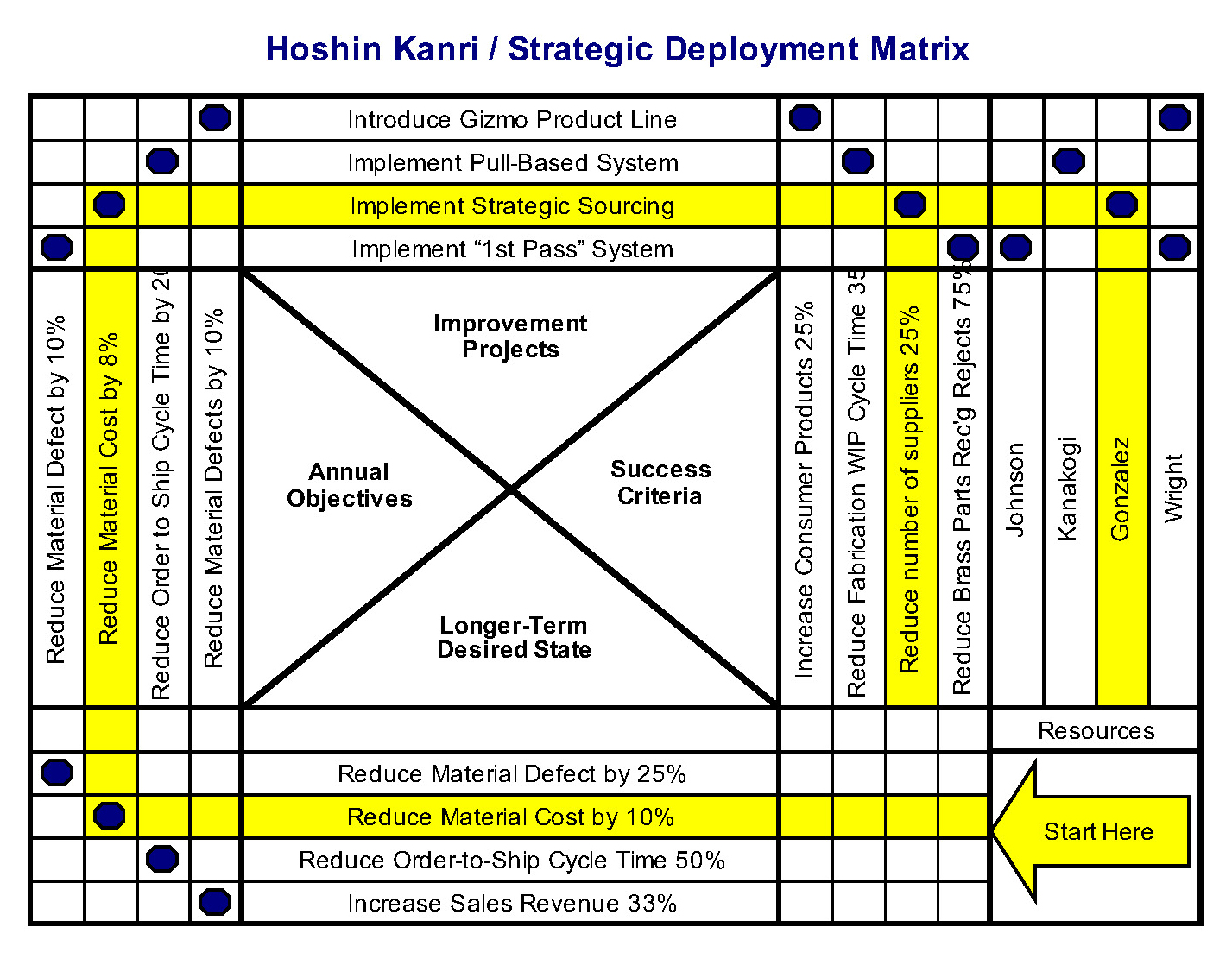
The Hoshin Kanri X-Matrix is a visual tool used to capture and communicate strategy deployment on a single page. It shows how long-term objectives, annual objectives, improvement priorities, metrics, and ownership all connect. The X-Matrix does not replace thinking—it makes thinking visible.
Its one-page format forces discipline. Leaders must make choices, clarify relationships, and explicitly assign accountability. Anything that cannot be clearly linked to strategic intent becomes suspect, prompting valuable discussion before execution begins.
More than a document, the X-Matrix serves as a shared reference point throughout the year. It supports dialogue, guides reviews, and helps teams understand how their work contributes to the bigger picture.
Understanding the Structure of the X-Matrix
The top section of the X-Matrix typically contains long-term breakthrough objectives, representing the organization’s future direction. These objectives provide context and purpose for everything else on the matrix.
The right side captures annual objectives, translating long-term intent into near-term priorities. These objectives are carefully chosen to ensure they are both ambitious and achievable within the year.
The bottom section lists key improvement priorities or initiatives—the major efforts required to achieve annual objectives. These are not exhaustive project lists, but strategic themes that guide improvement work.
The left side contains metrics and targets, defining how progress will be measured. Together, these sections create a coherent picture of strategy, execution, and accountability.
Ownership, Relationships, and Strategic Discipline
One of the most powerful aspects of the X-Matrix is how it visually displays relationships between objectives, initiatives, and metrics. Symbols or markings show the strength of each connection, helping teams quickly identify misalignment or gaps.
Clear ownership is essential. Every objective, initiative, and metric has an owner responsible for coordination, follow-up, and learning. This clarity reduces ambiguity and prevents strategic priorities from drifting due to lack of accountability.
When used properly, the X-Matrix becomes a powerful tool for strategic discipline. It encourages leaders to ask hard questions, make trade-offs explicit, and ensure that resources are allocated in support of the most important goals.
Review, Reflection, and Organizational Learning
Hoshin Kanri relies on regular review cycles to sustain momentum and promote learning. Monthly and quarterly reviews focus not only on whether targets are being met, but also on whether underlying assumptions remain valid.
When gaps appear, teams investigate root causes rather than assigning blame. This reinforces a culture of problem-solving and continuous improvement. Adjustments are made deliberately, ensuring the organization remains responsive without losing focus.
At the end of the year, structured reflection captures lessons learned. These insights inform the next planning cycle, allowing the organization to improve not only its results, but also its strategic thinking process.
Benefits of Hoshin Kanri
Organizations that practice Hoshin Kanri effectively experience greater clarity of direction. Employees understand priorities, see how their work matters, and are less distracted by shifting initiatives.
Hoshin Kanri also strengthens execution capability. By limiting objectives, establishing clear measures, and reinforcing regular review, organizations improve follow-through and reduce initiative fatigue.
Perhaps most importantly, Hoshin Kanri builds organizational alignment and engagement. Strategy becomes something people participate in, not something that happens above them. This shared ownership is a powerful driver of sustained performance.

Real-World Applications Across Industries
In manufacturing, Hoshin Kanri is often used to align safety, quality, delivery, and cost improvement across multiple plants. In healthcare, it helps align patient safety, experience, and financial sustainability. In construction and service industries, it brings focus and coordination to complex, multi-project environments.
In each case, the value of Hoshin Kanri lies not in the tools themselves, but in the disciplined thinking, dialogue, and learning they enable.
Conclusion: Why Hoshin Kanri Matters More Than Ever
In an environment of constant change and competing priorities, Hoshin Kanri provides a structured way to stay focused on what truly matters. It aligns vision with execution, balances discipline with adaptability, and turns strategy into a continuous learning process.
Organizations that commit to Hoshin Kanri do more than execute better—they think better. Over time, this capability becomes a powerful competitive advantage, enabling sustained improvement and long-term success.
Leave a Reply